
 Written by
 By Salas, E., Wilson, K. A., Burke, C. S., Wightman, D. C., & Howse, W. R. (2006)
REFERENCE: Salas, E., Wilson, K. A., Burke, C. S., Wightman, D. C., & Howse, W. R. (2006). A checklist for crew resource management training. Ergonomics in Design, 14(2), 6-15.
SOURCE: Published in Ergonomics in Design. Available online from Sagepub.com
Overview
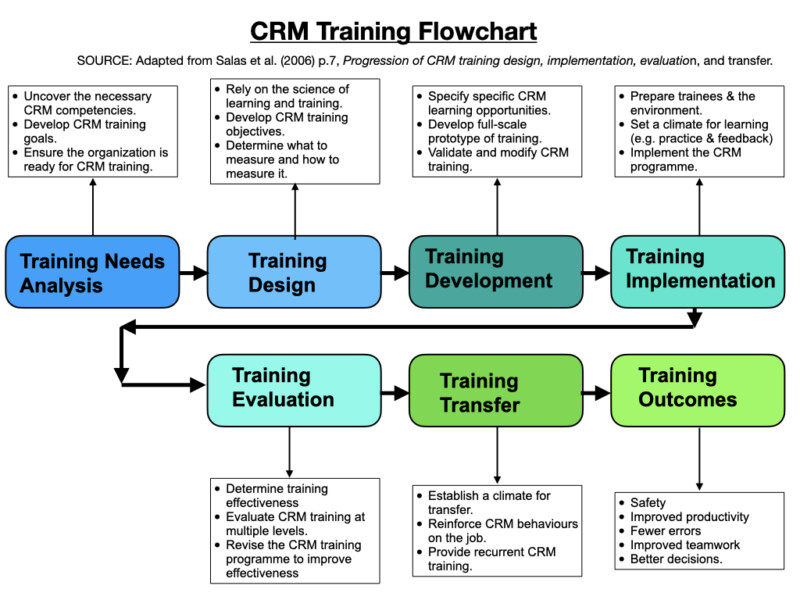
In 2006 Salas and colleagues presented a comprehensive, science-based checklist for CRM training design and delivery, intended to guide trainers systematically through the full training lifecycle. The checklist frames CRM not as a list of topics, but as a structured skills-development process grounded in learning theory.
A good primer for CRM trainers who are not familiar with core training design principles, the checklist introduces these in six phases: needs analysis, training design, development, implementation, evaluation, and transfer, and provides practical steps and expected outcomes at each stage.
Identifying CRM Competencies Through Needs Analysis
The authors emphasise that effective CRM training must begin with a detailed training needs analysis. This includes examining organisational goals, task demands, team interactions, available resources, and trainee experience levels.
They provide examples of core CRM competencies such as communication, leadership, decision making, mutual performance monitoring, adaptability, assertiveness, and shared situation awareness. Importantly, trainers are encouraged to select and prioritise competencies based on real operational requirements and tailored to their own operational environment rather than using generic CRM curricula.
Designing Training with Clear Learning Objectives
A central lesson for CRM training designers is the importance of writing specific, measurable, and behaviour-focused learning objectives. These objectives should clearly describe:
- What CRM behaviours trainees should demonstrate
- Under what conditions
- To what standard of performance
Objectives guide the choice of training methods, scenarios, and assessment tools, ensuring that CRM training focuses on observable skill development rather than general awareness.
Applying Teaching and Learning Principles
Salas et al. integrate well-established learning science principles into CRM design. Key points include:
- Creating an active learning environment
- Providing realistic examples of both effective and ineffective CRM behaviours
- Allowing repeated opportunities for practice
- Giving immediate, constructive feedback
Learning is described as an ongoing process rather than a single event, highlighting the need for recurrent training. The authors stress that technology and simulation are only effective when paired with sound instructional design.
Developing Realistic Scenarios
CRM scenarios should be carefully planned and storyboarded to target specific competencies and reflect realistic operational challenges. Well-designed scenarios allow trainees to practise CRM skills in context, build accurate mental models, and gain confidence in applying teamwork behaviours.
Effective Implementation and Feedback
Successful CRM training depends on well-prepared instructors and a supportive learning environment. Trainers should facilitate participation, guide scenario execution, and provide behaviour-focused feedback that highlights strengths, identifies areas for improvement, and suggests corrective strategies.
Evaluating Training and Supporting Transfer
The checklist promotes multi-level evaluation, assessing trainee reactions, learning, behavioural change, and organisational outcomes. Continuous refinement of training is encouraged based on evaluation data.
Finally, the authors highlight the importance of transfer to the workplace, supported by supervisors, organisational culture, and recurrent CRM training to sustain skills over time.
Key Insights for CRM Trainers
The paper’s main message for CRM designers is that effective CRM requires:
- Systematic, evidence-based training design
- Clear behavioural objectives
- Realistic practice with feedback
- Continuous evaluation and reinforcement
The checklist offers a practical roadmap for building CRM programmes that develop real teamwork skills and lead to lasting performance improvements.
Below is a short CRM design principles guide distilled from the paper
CRM Design Principles – A Practical Guide for Trainers
- Start with a real needs analysis
Identify the specific teamwork skills required for your operation (e.g. communication during high workload phases, decision making under pressure, mutual monitoring). Avoid generic CRM topics.
- Define clear behavioural objectives
State exactly what crews should do differently after training, under what conditions, and to what performance standard.
- Design for active learning
Use scenarios, simulations, role-play, and group problem solving rather than passive lectures.
- Provide realistic practice
Create scenarios that mirror operational challenges and require crews to apply CRM skills in context.
- Give immediate, constructive feedback
Focus on observable behaviours and solutions, not personalities.
- Evaluate at multiple levels
Measure learning, behaviour change, and operational impact—not just satisfaction.