
 Written by
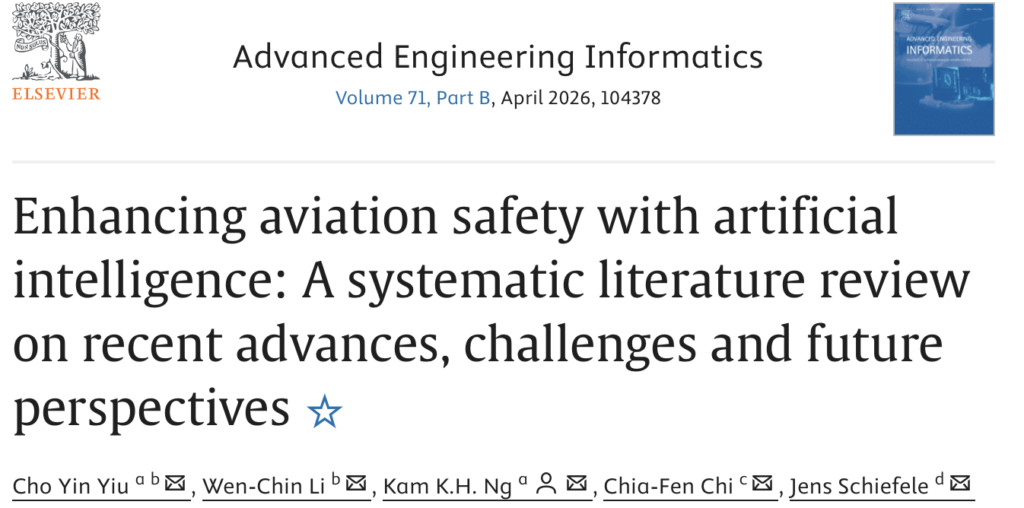
 Source: Journal of Advanced Engineering Informatics via Science Direct
We look at what a major new systematic review by Yiu et al. (2026) tells us about how artificial intelligence (AI) is rapidly changing the way aviation understands and manages human performance, with major implications for human factors research and Crew Resource Management (CRM) training.
The recently published (2026) review analysed 175 peer-reviewed studies from 2012 to 2024, which showed a sharp rise in AI applications focused on pilot workload, fatigue, stress, situational awareness, and decision-making, particularly since 2016. Rather than relying solely on self-reports or post-incident analysis, AI is increasingly being paired with simple physiological and behavioural data, such as heart rate, eye tracking, EEG, facial expressions, speech patterns, and flight data, to provide continuous, objective insight into how crews perform in real operational conditions.
Advanced machine learning models are now capable of identifying subtle patterns that signal rising cognitive workload or declining situational awareness long before performance visibly degrades. For example, time-based AI systems track how workload builds across different phases of flight, while visual-analysis models interpret sensor data to detect fatigue or attentional narrowing. Together, these tools are enabling a shift toward real-time human performance monitoring, offering powerful new ways to understand the human contribution to safety.
For human factors specialists, this represents a step-change in research capability. AI allows large volumes of operational data to be analysed quickly and consistently, making it possible to study workload, stress, and crew interaction in realistic settings rather than relying mainly on simulators or retrospective reports. This opens the door to more evidence-based models of human performance in complex environments such as degraded visual conditions, emergency operations, and high-tempo missions.
The implications for CRM training are equally significant. Instead of generic classroom scenarios, AI-supported monitoring could enable highly targeted training focused on moments where workload peaks, communication breaks down, or situational awareness narrows. Real operational data could be used to design CRM exercises grounded in actual human performance challenges, helping crews better recognise pressure, manage cognitive overload, and coordinate effectively under stress.
However, the review also highlights important limitations. Many AI systems remain difficult to interpret, raising concerns about trust and transparency. Regulators have yet to fully adapt certification frameworks for AI-driven safety tools, and poorly designed human-AI interaction could create new risks rather than reduce existing ones.
Overall, the review makes clear that AI is not just a technological upgrade, but it is reshaping how aviation can measure, understand, and train human performance. If implemented responsibly, AI has the potential to move human factors and CRM from largely reactive and subjective approaches toward continuous, data-driven, and operationally grounded safety improvement.
To access the full study in freely available PDF format – CLICK HERE
Reference:
Yiu, C. Y., Li, W.-C., Ng, K. K. H., Chi, C.-F., & Schiefele, J. (2026). Enhancing aviation safety with artificial intelligence: A systematic literature review on recent advances, challenges and future perspectives. Advanced Engineering Informatics, 71, 104378. https://doi.org/10.1016/j.aei.2026.104378
Fascinating insight by Yui into the potential uses of the AI data in shaping future CRM ground training. There is a real danger that classroom CRM stagnates, does not evolve and distances from EBT.
Great article😊
Hi Dave, Daan Vlaskamp and Alex Pollitt are working on publishing a paper on the future of CRM ground training that discusses just this topic – stagnation and future dynamics in training that will hopefully contribute to this debate! Interesting paper on AI as you say…