
 Written by
 SOURCE: Carine Lage on LinkedIn
This post on LinkedIn from aviation psychologist and helicopter pilot Carine Lage describes a mental health scenario based on a true account shared with her by a fellow pilot. It raises a debate about stress, fatigue, and pilot mental health that could be an interesting discussion point during CRM training sessions.
The following is a copy of the narrative.
For the full post on LinkedIn – CLICK HERE
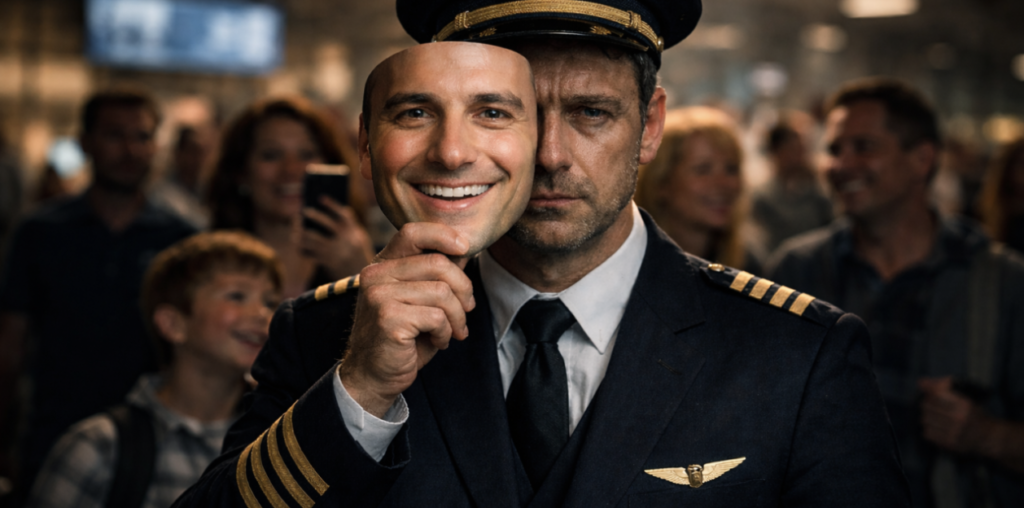
“A pilot must always be smiling, head down, facing problems as if nothing had happened.
He must listen to compromising proposals, accept them, and remain silent so as not to ruin other people’s long-desired dreams.
I chose this path. And with that choice, I also accepted the consequences.
Being a pilot means not having the right to feel unwell, Not having a life, Not having a home, Not having a family, if we look at it that way.
A pilot is always available to fly. He becomes a “necessary evil.”
He exists to enable other people’s happiness, to meet needs that are not his own.
With no right to get sick. With no right to fail. With no right to show vulnerability.
At work, the pilot is not a person, he is a tool.
The conditions inside the cockpit are real. The risks are real. The scenarios are multiple, dynamic, and critical.
Everything must be decided on the spot. There is no option to turn around and ask the passengers:
“And you, what do you think I should do?”
A doctor can consult another doctor. A lawyer can ask a colleague’s opinion. A dentist can stop, reflect, reschedule. A businessperson can make mistakes, adjust, and go back.
None of them faces an immediate risk of death when making a decision.
A pilot does.
In addition to risking his own life, he carries others, men, women, children, babies, and animals.
But he has no right to feel fatigue. No right to have financial problems. No right to suffer emotionally because of family or children. A pilot has no rights.
He exists to function.
And some people still think it’s easy. “Oh, but there’s autopilot.”
As if that eliminated the effort. It doesn’t.
A pilot’s work is predominantly mental, not physical.
One hour of flight is equivalent to four to six hours of high-pressure administrative work.
It is equivalent to two hours driving a heavy vehicle under constant tension.
A pilot’s fatigue does not show in the body, it shows in the mind.
So don’t think he isn’t working. Don’t think he is “just sitting.” Everything is being thought at 850 km/h. Everything is being anticipated miles ahead. Every decision already considers scenarios that may never happen, but must be ready.
Before the engine even starts, the pilot’s mind is already conditioned to deal with failures, risks, and consequences. He takes off already prepared for the problem that might arise.
Now comes the absurd contradiction. A machine requires care. Oil is changed. Parts are replaced when they wear out. There is maintenance every 100, 200 hours, depending on the program. There is monitoring, control, massive investment. And people proudly show how much they pay for it, because they know that without maintenance, the machine fails.
But the pilot? It doesn’t matter if he has a family. It doesn’t matter if he has children. It doesn’t matter if he is sick. It doesn’t matter if he is exhausted. It doesn’t matter if he is emotionally broken. Everyone just wants to board the plane, fly, laugh, enjoy the trip, and show it on social media.
They want the pilot to appear smiling, confident, flawless. As if he needed nothing.
The airplane needs maintenance. The pilot does not.
What kind of profession is this, in which a human being is worth less than the machine he operates?
That is why they say a pilot is a “necessary evil.”
Not because he is disposable. But because the system accepts the weight he carries, as long as he carries it in silence.
What a trap this profession is.”
The first step is acknowledging that this problem exists. The second is to stop normalizing silence.