
 Written by
 SOURCE: https://psychsafety.co.uk/pace-graded-assertiveness/ – Written by Tom Geraghty
Psychological safety is about creating a climate in which we feel able to take interpersonal risks in order to communicate our ideas, concerns and issues – and we want to be able to speak up in a way that we feel comfortable to. But that doesn’t mean we shouldn’t make an effort to articulate what we want to say in clear, accessible ways that allow the recipient to understand our intention and act on it appropriately
We want to communicate in ways that give the recipient the best chance of hearing and understanding the message. So it’s important to avoid communicating in ways that can come off as aggressive or rude; partly because it’s good to be kind, but also because most of us struggle to receive information that’s delivered aggressively or harshly – we’re more likely to become defensive in those cases – hearing not *what* is said, but *how* it was said instead.
But sometimes time is of the essence, and we need to quickly communicate an important message. This can be especially challenging if we’re communicating with someone across a power gradient such as to a surgeon in an operating theatre or the captain in a cockpit of a passenger plane. How can we do this respectfully and effectively, ensuring our words have the intended impact?
PACE: Probe, Alert, Challenge, Emergency
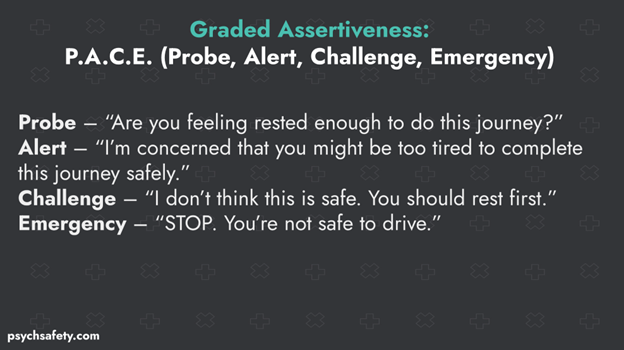
One way is to use “graded assertiveness”, which there are various models for (including a good one called CUSS), but my personal favourite is PACE. PACE allows us to begin with a low-threat question (a “Probe”). This may well be enough to cause the recipient to pause, consider and adjust their course of action. If it’s not, we can incrementally escalate to higher levels of urgency and assertiveness. It also means that if we’re wrong about our concern, beginning with a simple probe reduces the interpersonal cost of that mistake, and poses less risk of causing a “cry wolf” effect by going straight to emergency-level communication with a mistaken concern.
Using PACE, we first “Probe”, then “Alert”, then “Challenge” if necessary, and if we have to, we can resort to “Emergency”. I recently delivered a talk at a national highways safety conference, and introduced PACE as a method to effectively raise concerns to colleagues and peers as below:
As an example, let’s say Jane has noticed that her colleague, Bob, looks very tired and has already necked two cans of Red Bull. He has just climbed into the cab of his truck to begin a long journey. Jane believes that Bob is too tired to drive safely, and knows she should speak up, but wants to make sure the message is received well.
This is how Jane might use the PACE framework:
Probe – “Hey, Bob, you’ve got a long drive ahead, are you feeling rested enough to do this journey?”
Bob says he’s fine, and continues to prepare the cab of the truck, so Jane escalates to:
Alert – “Bob, I’m concerned that you might be too tired to complete this journey safely. Maybe you should take some time to rest before heading off.”
Of course, Bob wants to get cracking, so insists he’s ok and fires up the engine. Jane needs to make it clear that she’s not comfortable with Bob driving this tired, so moves to:
Challenge – “Wait Bob. I don’t think this is safe. Take a rest first.”
Bob’s lack of sleep is probably making him a bit irritable too, so he again dismisses Jane’s concern, and belts up ready to go. Jane knows this is her last chance to prevent a potential accident, so escalates to the emergency level:
Emergency – “Bob, STOP. You’re not safe to drive.”
At this point, there’s no ambiguity. Bob knows that he’s about to do something dangerous if he drives off, so stops the engine and gets out of the cab. Whilst Bob might be a little put out at having to rest before doing his drive, we’ve avoided potential disaster.
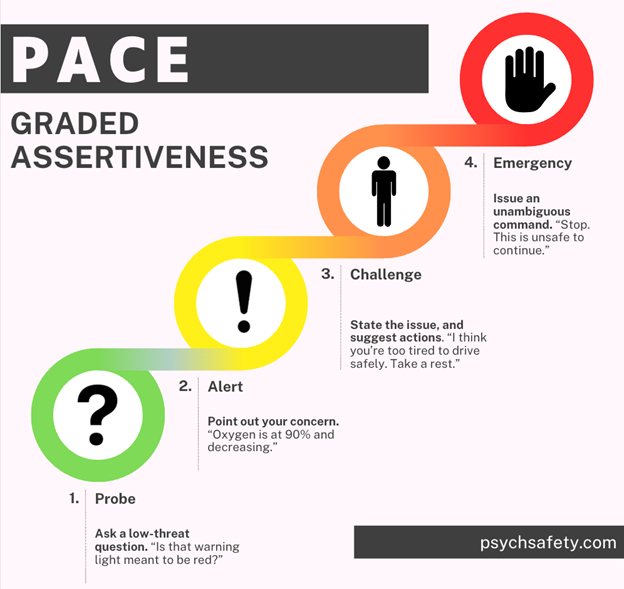
Of course, hopefully in most situations, we don’t have to escalate all the way to Emergency. Probing in itself can be a very effective trigger to cause someone to consider their actions or pause long enough to check they’re safe:
- “Are we on track with the patient’s breathing management?”
- “Have we successfully executed all the integration tests on this code?”
- “Do we have ATC clearance for take-off?”
Alerting can take many forms too, and can be enough to prevent an incident:
- “Oxygen is down to 90%.”
- “This release hasn’t yet passed all the integration tests.”
- “ATC say wait for clearance.”
Challenging someone in authority can itself be challenging, but knowing this framework and going through the steps can make it easier to do so, and bring a situation under control:
- “This is the fourth attempt at intubation. We should ask for assistance now.”
- “Deploying this code now could saturate our load balancers and bring down the service.”
- “We don’t have clearance for take-off. Hold position.”
And if these don’t work, we can escalate to the Emergency level, with a clear, unambiguous, decisive and forceful command. This can be uncomfortable, but it is much easier to do if we’ve already taken the previous steps. This usually consists of a decisive “STOP. This isn’t safe.” or similar approach.
Advantages of PACE
The very existence of a framework like PACE signals to people that it’s ok, and even expected that we speak up before something reaches an emergency state. Of course there might be extreme time-critical situations in which we need to escalate straight to emergency, but when there is time to make a more considered and graded intervention, PACE is an invaluable tool.
Another distinct advantage of PACE is that once we’ve learned it, we may recognise when others are using it with us. That in itself is a powerful signal that they’re trying to draw our attention to something important, and we can catch it before they have to escalate to emergency communication.
Because it’s most valuable in crisis or pre-crisis situations, it’s best to try to make it second nature before you find yourself in those situations, so practise it in simulations with your team, or if that’s not possible, simply practise it yourself so that it comes more naturally should you need to employ it. You can also display it on posters and discuss it with colleagues to help others to adopt it.
As a framework, PACE is used extensively in healthcare, aviation, maritime, and other domains. The PACE framework serves as a valuable tool for fostering psychological safety and effective communication about things that are important or safety-critical in high-stakes contexts. By structuring the escalation of concerns, PACE facilitates clear, respectful dialogue even across power gradients, and can significantly improve safety as well as day-to-day collaboration.