

 Written by
 Which is more dangerous: traveling by car or by plane? As a pilot, you likely know the statistically correct answer. However, if you ask a group of potential airline passengers, many might say that flying is riskier. Despite data showing that air travel is far safer, fear of flying is common, while fear of car travel is rarely discussed. This disconnect is an example of cognitive bias—”a systematic deviation from rational judgment” (Haselton et al., 2015).
Biases arise from heuristics—mental shortcuts we take subconsciously to avoid mental overload and make quicker decisions. However, these quicker decisions are not always optimal. Although we consider ourselves rational, pilots are not immune to these biases. A recent paper by Nadri et al. (2024) calls for more cognitive bias training in pilots. Let’s explore a few common cognitive biases that can influence decision-making in aviation.
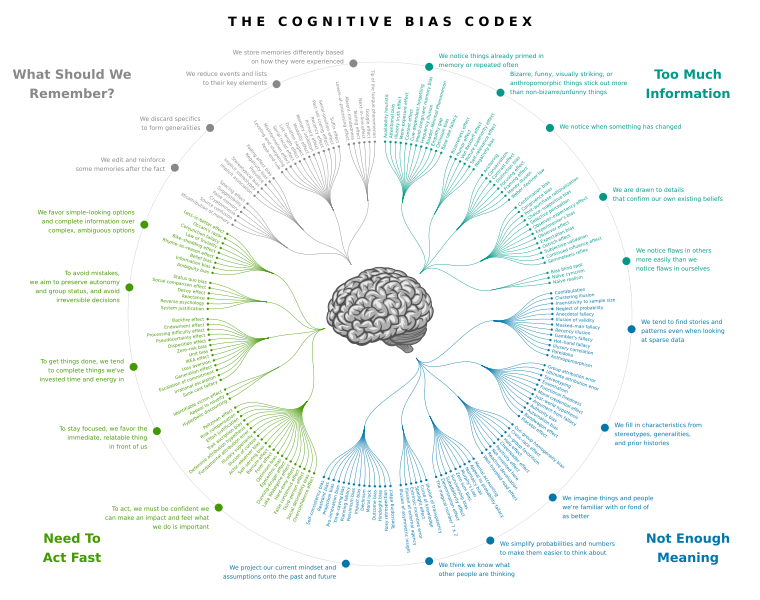
Figure 1. The cognitive bias codex.
Common Cognitive Biases in Aviation
Confirmation Bias:
Occurs when a pilot forms an initial understanding of a situation and then selectively seeks out information that confirms this view. New information confirming the mental model is readily accepted, while contradictory information is often ignored. For example, after deciding to divert to airport ABC based on a 30-minute-old weather report, a pilot might ignore reports of deteriorating conditions at that airport.
Expectation Bias:
Closely related to confirmation bias, expectation bias happens when a pilot sees only the information they expect to see.
Optimism Bias:
This bias involves being overly optimistic about an outcome, leading to ignored risks. For example, departing without deicing the aircraft under the assumption that snow will “blow off the wings” during takeoff.
Plan Continuation Bias:
Also related to confirmation bias, this is the tendency to continue with a plan once it’s been set, even when new information suggests it may no longer be the best option. It’s sometimes called “sunk cost bias” because the decision to continue is often influenced by the effort, time, or money already invested.
Availability Bias:
Making decisions based on readily available information, often because it is recent, dramatic, or frequently repeated. This is what affects passengers’ perceptions—airplane crashes dominate the media, while road traffic fatalities are underreported.
Outcome Bias:
Judging a decision by its outcome rather than the quality of the decision itself. For example, a landing from an unstable approach might end well, leading to the incorrect belief that it was a good decision to continue.
Anchoring Bias:
Relying heavily on the first piece of information received (the “anchor”) when making decisions. For instance, after days of dealing with strong crosswinds, a pilot might underappreciate the severity of a 30-knot crosswind because it seems mild by comparison.
Hindsight Bias:
In reviewing accidents or incidents, it’s easy to fall into hindsight bias, where the outcome is used to unfairly judge the decisions made by pilots, ignoring the fact that they did not have the benefit of knowing the outcome in advance.
Tips for CRM Training on Biases:
- Create Awareness of Biases:
Educate pilots on common cognitive biases and how they can affect cockpit decision-making. - Train Critical Thinking Skills:
Encourage pilots to systematically evaluate all available information before making decisions, considering multiple perspectives. - Enhance Communication Skills:
Improve communication among crew members to ensure that all voices are heard and critical feedback is encouraged. - Use Structured Decision-Making Tools:
Introduce models like T-FORDEC or T-DODAR to provide a clear framework for decision-making under pressure, reducing the risk of bias. - Implement Startle Management Tools:
Train pilots in techniques to manage stress and emotions, which can exacerbate biases during high-pressure situations. - Incorporate Threat and Error Management (TEM):
Teach pilots to anticipate and mitigate potential threats and errors, enhancing their ability to identify and counteract biases. - Train Situational Awareness Skills:
Develop pilots’ situational awareness to help them stay alert to the entire operational environment, catching and correcting biases early. - Learn from Case Studies and Experiences:
Use real-life case studies to illustrate how biases have impacted decision-making, providing valuable lessons to avoid similar pitfalls.
For further reading, The Decision Lab offers an excellent overview of biases (not specific to aviation) with explanations in plain language. The Decision Lab
References and Resources:
- Haselton, M. G., Nettle, D., & Andrews, P. W. (2015). The evolution of cognitive bias. The handbook of evolutionary psychology, 724-746.
- Nadri, C., Regalado, J., Ferris, T., & Zahabi, M. (2024, August). Cognitive Biases in Commercial Aviation: Empirical Review of Accident Reports. In Proceedings of the Human Factors and Ergonomics Society Annual Meeting.
- Skybrary: Cognitive Bias
- Flight Safety Australia: Seven Deadly Shortcuts
- Airline Safety Blog: Cognitive Bias in Aircraft Accidents
- The Decision Lab: Biases