
 Written by
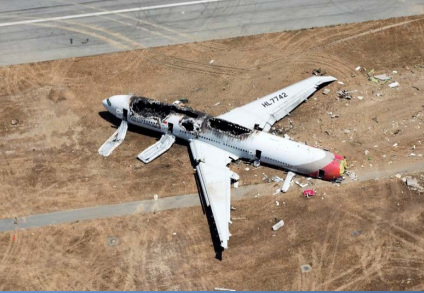
 This accident has become a popular favourite as a case study on the main theme of automation, but there are a host of other human factors in including culture, crashworthiness, survivability and emergency response that make it a good choice for an in depth case study. There is plenty of material out there for trainers and interested parties as well as the thorough final report from the NTSB. We link you to some key resources below…
Source: Youtube
For a good written case study review see CODE7700
For further information see Aerossurance’s summary review.
Full NTSB accident report: ASIANA FLIGHT 214 ACCIDENT REPORT
The NTSB Probable Cause cited:
….the flight crew’s mismanagement of the airplane’s descent during the visual approach, the PF’s unintended deactivation of automatic airspeed control, the flight crew’s inadequate monitoring of airspeed, and the flight crew’s delayed execution of a go-around after they became aware that the airplane was below acceptable glidepath and airspeed tolerances.
Contributing to the accident were
(1) the complexities of the autothrottle and autopilot flight director systems that were inadequately described in Boeing’s documentation and Asiana’s pilot training, which increased the likelihood of mode error;
(2) the flight crew’s nonstandard communication and coordination regarding the use of the autothrottle and autopilot flight director systems;
(3) the PF’s inadequate training on the planning and execution of visual approaches;
(4) the PM/instructor pilot’s inadequate supervision of the PF; and
(5) flight crew fatigue, which likely degraded their performance.
Animation video of Asiana Flight 214 accident sequence
For footage of the accident sequence and crash rescue see video below.