
The need for speed: How slowness has a value of its own.
This article by Alex Pollitt challenges the common assumption that faster responses always indicate greater skill or competence. It argues that slowness can reduce errors,

This article by Alex Pollitt challenges the common assumption that faster responses always indicate greater skill or competence. It argues that slowness can reduce errors,

This article by Alex Pollitt recounts a serious inflight emergency after multiple, interacting failures, including smoke in the cockpit, loss of control inputs, engine overspeed

In this article, Alex Pollitt argues that labelling complacency as a cause of errors in aviation (and human performance generally) is overly simplistic and unhelpful.

Distributed situation awareness: what is it? This article explains how the traditional understanding of situation awareness, originally defined as a cognitive process inside an individual’s

In this article from competent aviators.com Alex Pollitt examines the limits of cognitive performance and how we can mitigate cognitive overload.
Any conscious mental processing

We discuss how CRM training for experienced crews must move beyond reinforcing familiar concepts and instead focus on recalibrating judgement and behaviour in realistic operational

This brand new (2026) review by Okine and colleagues presents one of the most comprehensive examinations to date of how human factors (HF) research has

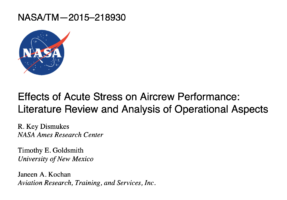
An easily readable source of quality information on the effects of stress and its impact on attention, decision making and teamwork, NASA’s technical memorandum Effects

Old, but not outdated, these two documents from 1988 give an example of how trainers can develop scenario based, table-top exercises, to facilitate learning in

In this post from LinkedIn, Aviation Psychologist and Human Factors Specialist Aleksandra Kapela discusses the importance of the instructor in CBTA implementation.