 Written by
 Source: The Royal Aeronautical Society
Are lengthy, outdated flight deck briefings really contributing to aviation safety?
“briefings have become one-size-fits-all solutions serving as repositories for redundant verbal crew crosschecks of highly automated, highly reliable systems.”
This article by Captains Rich Loudon and David Moriarty from the Royal Aeronautical society Human Factors Group argues that we need to rethink the way we brief operationally and looks at the specifics of what makes a good cockpit brief and why.
Check out the full article at this LINK
The article argues that it is time to rethink the way we brief based on a methodology that incorporates recent breakthroughs in cognitive theory regarding decision-making. After a year of research and development, they came up with four goals for briefings:
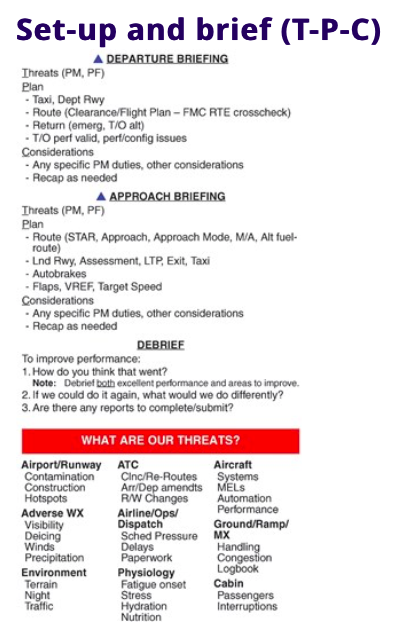
1. Threat Forward. Following the law of primacy (that information presented first is better retained), crew departure and arrival briefings should first address the relevant threats to the flight and go on to discuss specific countermeasures that could be employed should any of those threats degrade safety margins. An additional benefit of a threat-forward briefing is that, in identifying relevant threats early in the briefing, those threats tend to positively inform the subsequent departure or arrival plan.
2. Interactive. The briefing design should encourage interaction between the PF and PM. It is time to put away the age-old notion of ‘my leg, your leg’. The desired goal should be an ‘our leg’ mindset where the PM plays a leadership role in developing critical content of the briefing. After all, industry accident data continues to reveal that it is the PM that will play a significant role in noticing and re-establishing safety margins should they deteriorate.
3. Scalable. Just as no two departures or arrivals are the same, neither should be the briefings that precede them. Yet, on today’s modern flight decks, crews are required to go through the same litany of items for each and every flight leg. Crew briefings need to be scalable. Professional aviators know how to discern what is important based on proficiency, familiarity, flight complexity and a host of other factors that may or may not be relevant at the time.
4. Cognitive. Finally, following the principle of recency (that information presented last is also well retained), crew departure and arrival briefings should conclude with a recap of the critical threats and associated countermeasures, as well as specific PM duties for each particular departure or arrival. Why is this so important? Dr Gary Klein, a leading researcher in recognition-primed decision-making theory, has determined that professions requiring rapid decision-making in high workload environments subject to rapidly changing conditions (ie fire-fighting, law enforcement, military and aviation), will involve decisions based on recognition-primed pattern-matching. A pattern match, according to Klein, is an action that is derived from relevant cues, expectancies, and goals. These cues, expectations and goals will normally be a result of insights and expertise gained through specific training or routines, professional study, deliberate practice, or overall experience. In very rare cases, such as Sully’s ‘miracle on the Hudson,’ experts will seek a pattern-match that is ‘close enough’ because the situation is unfamiliar to them, requiring some level of improvisation. In any case, a successful outcome will require an appropriate pattern match. For this reason, flight crews should brief in a manner that will serve to prime them with potential pattern-matches. Once these pattern-matches and the cues that should elicit them have been mentally primed, it is a lot more likely that when an abnormal situation arises, the crew will be able to trigger these pattern-match based responses quickly and accurately.
An example of a threat forward briefing format: