
 Written by
 The Johari window can be a useful tool in leadership development. See article below by Jade Garratt
By Jade Garratt, Director of Education. From: https://psychsafety.co.uk/the-johari-window/
Like many, I was first introduced to the Johari Window in leadership development training. It was presented as a tool to understand yourself, and it was used to demonstrate how feedback can help to reduce your “blind spots” about the way you are perceived by others. What is the Johari Window?
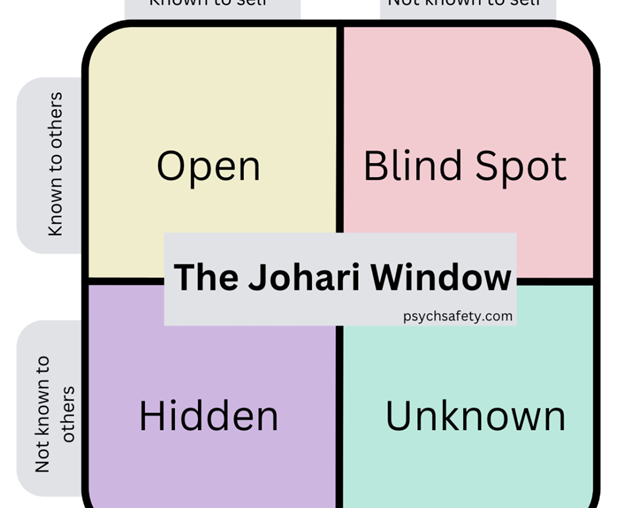
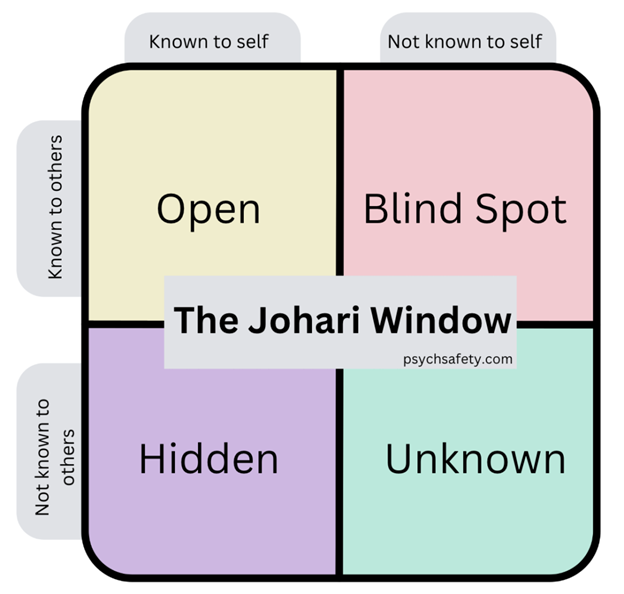
If you’ve not come across it before, the Johari Window is a quadrant diagram, which plots descriptors that are “known to self” against those that are “known to others”, with all combinations of those in between. The four quadrants (sometimes called the “four rooms”) are therefore:
- Open – aspects that are known to you and to others. May also be called the area of “free activity”.
- Hidden – aspects that you know about yourself, but are not shared with or known by others.
- Blind spot – aspects that others know about you, but you do not know about yourself.
- Unknown – aspects that neither you, or others know about yourself yet, or, depending on how this tool is used, descriptors that do not apply to you.
Value of the Johari Window
As we know, “all models are wrong and some are useful”. This one can be very useful, and for lots of us the idea of reducing blind spots through feedback is appealing. It gives us a framework for increasing our self-awareness and beginning to examine our behaviour in relation to others. It also offers one way to model how we might learn and grow as we work with and get to know others – in Johari terms, we likely want to increase the size of our open area and decrease the hidden area and our blind spot in order to improve the way we work and communicate with others. As Joseph Luft, co-creator of the model, brilliantly put it:
“A centipede may be perfectly happy without awareness; but after all, he restricts himself to crawling under rocks.”
However, we do need to use it with some caution. Here’s why…
History of the Johari Window
The Johari Window was created by two psychologists, Joseph Luft and Harrington Ingham, and first presented at a HR conference in California in 1955* (Johari is an amalgamation of their shortened first names, and is pronounced as they are: Joe-Harry). It seems it made an impact that neither of them were expecting**, and Joseph Luft wrote later that they were “surprised to find so many people, academicians and non-professionals alike, using, and tinkering with, the model.”
It is reported that the Johari Window was actually designed to be used as an exercise or technique. The idea is to give a person a list of adjectives, and see which they pick to describe themselves. Then you give the same list of adjectives to their peers or colleagues, and see which they would pick to describe that person. After that, the adjectives are sorted into the quadrants according to which were chosen by the subject but not others (hidden), chosen by both (open), chosen by others but not the subject (blind spot) and chosen by neither (unknown).
It might end up looking something like this:
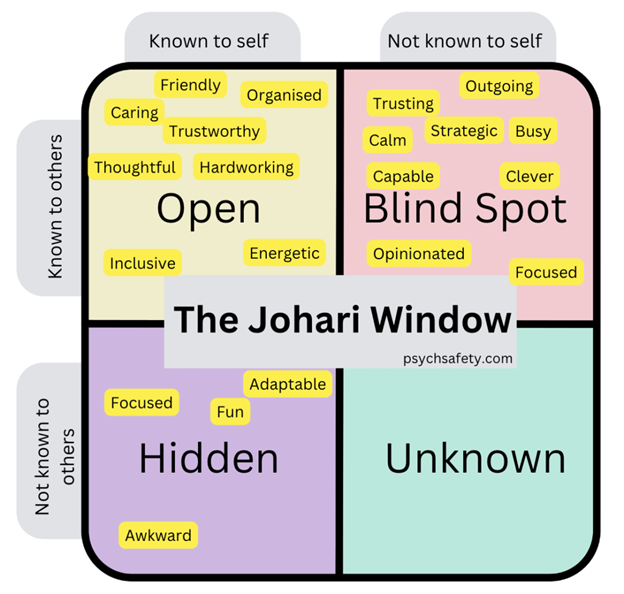
In this application, it’s clear that the Johari Window is a tool to explore how we perceive ourselves, what we self-disclose, and how others perceive us. Where there are differences, that can be cause for self-reflection and learning. This might be especially useful if we’re doing some work on our “work persona” or our “leadership persona” and want to better understand how we come across to people.
Different Applications of the Johari Window
Any tool and approach can be used and adapted to different contexts and there are multiple ways that the Johari Window can be used with different exercises where it might provide useful insights.
One key use is as a helpful visual to demonstrate that we all have a “Hidden” area. The Johari Window can remind us that as we build relationships with people we can intentionally choose to disclose aspects of ourselves or our lives to them. This can be seen as reducing the size of our Hidden area and increasing the size of our Open area. Equally important, we might use it to be more intentional about what we keep in our Hidden area. For instance, teachers might think very carefully about which aspects of their Hidden area they choose to share with their students, and which they choose to keep private.
In this way, the Johari Window might be a good model to introduce when working with colleagues on developing Personal User Manuals or READMEs. With this framework in mind, we can be quite deliberate about what we choose to share and bring into the Open area.
Common Misunderstandings about the Johari Window
However, where it’s perhaps misleading is to see the Johari Window presented not as this particular technique, or indeed as a model for human interaction, but as a model of “The Self.” A quick bit of google research reveals a range of leadership and coaching articles claiming that the Johari Window helps to “reduce conscious and unconscious biases” and urging people to eliminate blind spots and change their behaviour so that they can be judged more favourably by others.
This is probably a stretch, for a number of reasons.
Firstly, the Johari Window is a tool used to explore perceptions of ourselves, including those we hold and those others have of us. We don’t have to agree and internalise the descriptors others might use of us. After all they are seeing us through the lens of their own prejudices, biases and stereotypes.
And there’s a broader point here (that applies to most feedback) – our perceptions and perspectives are subjective. “Known” by others is actually just their perception. It might be “their truth” but we need to be careful not to muddle this with some absolute truth about the person in question. A particular concern about this is that we know that the same behaviour can be perceived in different ways dependent on their person’s gender – for instance a woman expressing anger might be perceived as overly emotional, while a man doing the same might be considered passionate or full of conviction, and this intersects with race too – a the black woman might be labelled aggressive while a white man is is called assertive, for very similar behaviours.
Even if we do the exercise as originally described by Luft and Ingham, we need to remember that these adjectives may not give us anything we can recognise as clear, actionable “feedback”. For feedback to be truly useful, it ideally needs to be specific, not just vague descriptors. From a psychological safety perspective, if we give someone a list of adjectives without further explanation, it’s easy to see how it could increase anxiety – Why do they see me like that? Am I always that? Does everyone see me this way?
The risks of misuse of the Johari Window
And as a final note on the Johari Window, when we talk about kind, compassionate and actionable feedback, we try to separate a discussion about someone’s behaviour from wider (and often unfair) assertions about their character and who they are. Misused, the Johari Window risks doing the opposite – it merges the feedback with a representation of “the self”.
References/ Further Reading:
Psychological Safety and Giving Feedback
An interesting essay from William Bergquist on the Johari Window
Article from Joseph Luft on the Johari Window
*Despite our best detective work, we’ve not been able to track down and read the original paper for this, though plenty of articles online use the following citation: Luft, J., & Ingham, H. (1955). The Johari Window, a Graphic Model of Interpersonal Awareness. Proceedings of the Western Training Laboratory in Group Development, 246, 2014-03.