
 Written by
 Safety Listening
The well-known accident in Tenerife in 1977, where two 747’s collided on the runway, has made training in speaking up about safety concerns an essential element of pilot CRM training. Recent research by Noort et al. (2021) shows that there is another dimension to this issue that has been given less attention in our training: safety listening.
Speaking up about perceived hazards is called safety voice in academic safety literature. In high-risk industries, such as aviation, safety voice is of vital importance. Speaking up about concerns increases shared situation awareness and prevents accidents. Safety listening refers to how attentively and seriously senior crew members respond to safety concerns raised by others. Effective safety listening involves not only hearing the concerns but also engaging in meaningful dialogue and taking appropriate action. The more a senior crew member engages in safety listening, the more likely the junior crew member is to speak up. This relationship is depicted in figure 1. First, a risk or threat needs to be perceived. The bigger the perceived threat, the more likely an individual is to engage in safety voice. Where in the case of a minor threat one might choose to be silent to avoid uncomfortableness, a life-threatening situation will provide a lot more incentive to speak up. Safety voice is subsequently influenced by safety listening: the degree to which concerns are taken seriously. For action to be taken, concerns need to be heard as well and taken seriously.
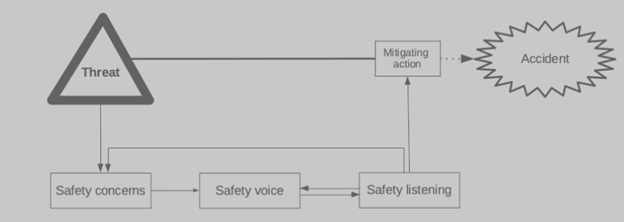
Figure 1 – The influence of safety voice and safety listening (Noort et al., 2021).
One of the factors influencing safety voice is power distance (a concept introduced and studied by Geert Hofstede). In a setting where power distance is perceived to be greater, junior crew members are less likely to speak up, fearing that the negative consequences of speaking up outweigh the benefits. CRM training has worked on reducing power distance with some success. CRM training has also improved safety voice for lower power distance countries and by cultivating improvements in communication and crew situation awareness, might have reduced the need for it.
The researchers that wrote this paper analyzed 172 CVR transcripts of real aviation accidents. The results showed that, against their expectations, in almost every single accident flight crew members voiced their concerns. However, they were often ignored, or the concerns were poorly received. This indicates that lack of safety voice is not a primary cause of accidents. Poor safety listening was a significant factor in accidents however – suggesting that simply focusing CRM training on speaking up is not enough: safety listening needs to be addressed too. This is especially true for cultures with a high-power distance.
What does this mean for us as CRM-trainers and pilots? Noort et al. acknowledge the positive achievements of CRM training, and the importance of training pilots to speak up, so a lot has been done well. However, it should be emphasized more that speaking up is a two-way street. CRM training should include strategies for senior crew members on how to effectively respond to concerns, such as engaging in open dialogue, validating the concerns, and ensuring that appropriate actions are taken. This approach fosters a culture of psychological safety, where all crew members feel valued and heard. As with many things in our cockpit, it is a team effort and not just the responsibility of the most junior crew member. Lastly, knowledge on human performance effects that get in the way of effective communication (for example mental overload) will help in getting the message across at the appropriate time and in the most effective way.
Article based on:
Noort, M. C., Reader, T. W., & Gillespie, A. (2021). Safety voice and safety listening during aviation accidents: Cockpit voice recordings reveal that speaking-up to power is not enough. Safety science, 139, 105260.