
 Written by
 Source: UK CAA CAP737 Flight Crew Human Factors Handbook
Chapter 2 – Perception
Incoming stimuli need to be quickly interpreted to know roughly what is being
sensed. This process of perception is generally unconscious, fast and
effortless. For centuries, people have created optical Illusions that act to ‘fool’
the perceptual process (illusions are designed to create a misperception; i.e.
there appears to be a difference between what you perceive and what is
‘true’).
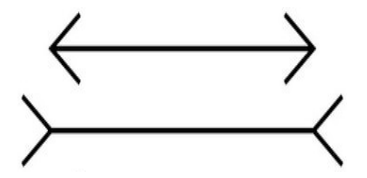
Figure 4. The Müller-Lyer Illusion by F.C Müller-Lyer 1889. The two parallel
lines are of equal length, but most people perceive the top one to be shorter.
The exact reason for this is still debated.
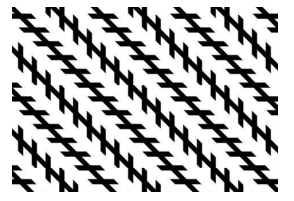
Figure 5. The Zöllner illusion (Johann Karl Friedrich Zöllner, 1860). The
diagonal lines are all parallel, but due to the short horizontal and vertical
cross-lines, they do not appear so. The exact reason is also still debated.
The essence of the perceptual process is that it combines existing knowledge
with incoming stimuli and the current situation, in order to create meaning
from what is being sensed. In other words the brain takes a very quick ‘best
guess’ as to what the stimuli represent based on what it has learned about
previous stimuli in similar conditions.
As well as the object being perceived, the context around the object also
feeds the perceptual process of that object. A good example is a form of
illusion created by the suggestion of perspective in two-dimensional images,
such as classic convergence illusions like the one in fig 6 below.
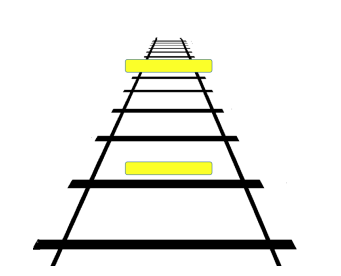
Figure 6. Classic Perspective Illusion
Sometimes called the Ponzo Illusion, putting two identically sized objects on a
scene with suggested perspective causes one object to be perceived as
larger than the other. This is because the brain naturally compensates for the
perspective as it would in the real world (objects nearer the horizon or closer
to the vanishing point are perceived as further away, and the size is
unconsciously compensated for by the perceptual process).
Like all tasks, piloting an aircraft relies on constantly updated perceptions, but
on rare occasions the process will inevitably lead to the brain ‘guessing’
wrongly about the meaning (or properties) of an object.
‘Top down’ or ‘bottom-up’?
There is plenty of scientific debate about the amount of perception that is
driven by the stimulus (bottom-up) and the amount driven by the brain itself
(top-down). This is a highly complex area and to avoid a large discussion, it
can be simplified by stating that the perceptual process combines experience
and expectation with sensed information, and can be most usefully
considered as a predominantly ‘top-down’ process at its most ‘pure’. It should
be noted that the above notion does not relate to ‘top-down’ and ‘bottom up’
processing (which is not referred to in these terms in CAP 737).
Which comes first: noticing or perceiving?
In terms of information acquisition, there has long been a scientific debate
about which comes first: the drawing of attention to a stimulus (noticing) or
the perceiving of that stimulus (what it is). Because most everyday
information is within the bounds of our expectation and experience, it is
practical to consider that perception usually occurs first, though this is a huge
over-simplification. To avoid a complex but fascinating indulgence into the
science, it is useful (and generally correct) to consider that many things will
get perceived whether they catch our attention or not, but only some things
will draw our attention (either because of their physical characteristics or the
meaning around them). Hence, most of what catches our attention has been
or will be perceived. Hence, we perceive more than we attend to.
Application of knowledge – Perception
This section explains common perceptual illusions in flying.
The single most important learning point regarding perceptual illusions is well
established in aviation: pilots are rightly trained that unless obviously wrong,
instrument readings should be prioritised over perceptions created by the
sensations of flight (both vestibular and visual). It may be worth the CRM
instructor recapping these illusions in order to reinforce that important point,
and showing the number and breadth of situations to which it applies.
Glideslope
The need for VASIs and PAPIs stem from the difficulty that all pilots have (to
varying extents at various times) in accurately judging the right glideslope
angle using purely visual judgment. There are no reliable natural visual cues
for glideslope angle. The raw, uncorrected shape (a trapezium) that a runway presents to the eye during a final approach (known as form-ratio) is said to be one of the most important cues for the perceptual process in judging the glideslope. Because of this, one of the most common perceptual illusions is caused by a sloping runway surface. A runway that slopes downhill, away from the pilot is likely to generate a high approach (as the pilot attempts to maintain the normal perception of form-ratio). This could lead to a high-energy approach (to a downhill sloping runway) and the risk of an overrun. Equally, an upward
sloping runway, as viewed from the pilot, may cause a low approach for the
same reason. Hence it is important that whatever the runway shape seems to
suggest about the glideslope, technical sources of glideslope information are
carefully monitored (whether PAPI, ILS glideslope etc.) even on a visual
approach. These illusions are unlikely to cause consequences in isolation, but
can contribute to a situation.
As well as the sight of the runway, ground cues such as texture and horizon
play an important role in maintaining the correct perception of the glideslope.
The perceptual limitation inherent in judging approach path angle is
particularly critical when there are no outside visual features other than the
runway or helipad. Normally, when visual with a runway a pilot will also use
ground cues some of which will become increasingly visible in their peripheral
vision as they descend (such as ground texture). If these cues do not appear
as normal, it can lead the pilot to unconsciously understand the reason for
their absence as excess aircraft height. Hence in situations where there are
no ground cues (such as night time approaches over desert or unlit water) the
common and strong impression (perception) can be that the aircraft is high on
the glideslope. This is dangerous because it leads the pilot to descend (i.e.
depart from the glideslope). This specific illusion is often called the black-hole
illusion, due to the apparent visual ‘black hole’ between the aircraft and the
runway.
It was a dark but clear night with no horizon and our destination, a lone
platform, could be easily seen with some distance to go. I briefed the
approach and we commenced the descent. During the descent I was aware
that something was not right. I understood that given my altitude and range
from the platform I was too low, yet visually the approach appeared to be
steep. I was aware of the black hole approach illusion having briefed it many
times during CRM training, yet I was unprepared for the strength of the
illusion I was now encountering. My co-pilot had fortunately been vigilantly
monitoring the situation and re-orientated me with a command to climb.
Height
Visual height illusions can be potentially dangerous in visual flight regimes
such as military low flying, helicopter operations or general aviation, but even
occasionally in commercial airline operations. An illusion might be innocuous
by itself, but if workload is high due to other tasks then such illusions can
cause problems, particularly below a thousand feet.
Numerous factors feed the visual perception of height, including:
- The visibility of texture and detail that can be seen on the ground, and the size of known objects (i.e. houses and animals).
- The relative speed of ground texture flow (the slower that the ground seems to be moving relative to the viewer, the further away it is perceived to be).
- Perspective and shape, e.g. of buildings, mountains, runways etc.
- Known landmarks, distances and angles.
Miniaturized ground objects (miniature trees, small fields) can give the impression that the ground is further away than it is. Likewise, larger than expected objects can make the ground seem closer than it really is. The commander (PF) was carrying out some SAR training approaches to a mountain peak at night using night vision goggles. The summit was strewn with large boulders and with no other object for reference the commander perceived the boulders to be smaller than they were. Several approaches were made and on each occasion the commander went around believing he had become too low.
Poor visibility can also make ground objects seem further away (removing the colour and clarity associated with close objects). Flying very slowly and/or into a strong headwind can contribute to a perception that the aircraft is higher than it is and this can be exacerbated with ground lights at night. Night also removes many perceptual cues, particularly ground detail. Changes in the spacing and brightness of ground lights can feed illusions (roads, houses, etc.). Featureless terrain, water and glare remove several cues to height. Loss of perceptual cues can put a slightly heavier burden on a pilot to pay attention to height.
Speed
Humans have evolved ways of perceiving the speed of their movement, but
for obvious reasons humans have not evolved a perceptual process for
airspeed, only for speed (and only within a narrow band of meaning). A major
natural cue for perceiving the speed of one’s movement is texture flow,
usually in peripheral vision. Other cues can also factor such as noise (volume
and pitch change), perception of attitude (nose-low attitude can be mistaken
for speed), buffeting and control response, and vestibular acceleration cues.
Difference between speed and airspeed may be learned but even then,
movement cues will feed a sense of airspeed. Aerobatic and post-stall
accidents frequently occur when pilots apply too much back-pressure to the
control column because the nose-down attitude gives the impression of
sufficient airspeed before the airspeed has built up in the dive, leading to a
secondary stall or flick. This can be a fatal misperception of speed caused by
use of an unreliable cue.
Substituting ground speed cues for airspeed indications is common, since the
perceptual process can perceive actual motion intuitively, but airspeed is far
less intuitively obvious. A disproportionate number of accidents are caused
after turning downwind during pylon racing (Eshelby 1996) almost certainly
for this reason. Another example occurs where gliders stall and ‘flick’ while
rotating into the climb during winch launching, usually resulting in serious
(often fatal) accidents. A disproportionate number of such accidents happen
in calm conditions. Because pilots factor natural cues into their sense of
airspeed during the moments of launch (texture flow, acceleration and time
elapsed) their timing of the rotation into the climb is skewed by the ground
speed, despite that being irrelevant compared to the airspeed. Due to this,
calm conditions can cause launches to err towards early and steep rotations
and high angles of attack, occasionally just enough to stall a highperformance glider (which account for most such accidents despite
accounting for a fraction of such launches).
Aerobatic and airshow pilots performing low rolls or other ‘airspeed-critical’
manoeuvres downwind are also vulnerable, as are general aviation aircraft
after engine failure on climb out (i.e. turning back downwind for a landing).
Although the message seems simple (“use the airspeed indicator”) in practice
this may not be easy in certain situations because perception is powerful and
not under conscious control.
Late on in the approach my mind was focussed on the very short runway.
Things seemed ok: the nose seemed higher than normal but there was no
sensation of losing airspeed. I remember momentarily thinking that it must be
to do with the airfield sloping (I had not landed here before). As I flared, the
aircraft didn’t seem to respond at all and just fell onto the runway very heavily
(fortunately without damage). I later realised that I had landed with at least 15
knots of tailwind, and had probably run out of airspeed by the flare. The
tailwind must have given me the impression of speed and I had clearly not
properly monitored the airspeed indicator.
The above anecdote is a good example of the power of ground cues to feed
perception, particularly when under high workload. This effect has contributed
to many serious accidents. In 2008, an Extra 300 aerobatic aircraft transiting
an air display was destroyed and its passenger seriously injured after
worsening weather led the pilot to make an emergency landing in a field. The
tailwind component was between 10 and 15 knots. The following section is
from a UK AAIB report:
In assessing speed at low level, pilots use a number of cues: primarily the
airspeed indicator, but also the power setting and attitude, the feel of the
controls and the impression of speed, sensed in the peripheral vision, by the
rate at which the ground texture passes by. This last cue has been identified
as being particularly powerful and difficult to ignore, and is known to have
been a factor in the context of downwind landing accidents. It is possible that
this impression of increasing ground speed as the aircraft turned downwind
influenced the pilot inadvertently to allow the airspeed to reduce until the
aircraft stalled, at which point there was insufficient height in which to recover
control (AAIB 2009).
Attitude and Bank angle
The inner ear has small receptors that pass information to the brain. Head
orientation information is sensed using otoliths. These can be considered as
little spirit levels (they have lots of little hairs with tiny weights on at the end,
that bend whenever the head tilts). Head rotations (accelerations) are sensed
in three dimensions by three semi-circular canals (fluid filled tubes in a
circular shape).
The perception of gravity can be masked (indeed replaced) by aircraft bank
angle or acceleration. This means that a pilot can have a perception of being
upright when they are banked, and vice-versa. This does not usually fool
visual perception and it is therefore useful that visual perception is prioritized
naturally; except when there are insufficient natural visual cues of the outside
world. An additional limitation with the vestibular system is that it requires a
threshold of acceleration or displacement in order to be perceived. Hence, if
orientation changes slowly, that change may be invisible to the perceptual
process.
The classic problem is often called ‘the leans’ and occurs in IMC (or even on
a dark night) as follows: a gradual increase in bank angle occurs unnoticed to
the pilot. The pilot then notices the bank angle on the attitude indicator (e.g.
artificial horizon) and rolls the aircraft back to level flight. The vestibular
system only senses this second ‘counter’ roll (returning the aircraft to level
flight) but not the first roll that banked the aircraft gradually. The net vestibular
perception therefore becomes that the aircraft is now banked, when it has in
fact returned to level flight. This gives the pilot a feeling of being banked
despite the attitude indicator showing proof that the wings are level. Because
the attitude indicator is small (uses foveal vision) this illusion is not overcome
by visual perception, and so the erroneous feeling of being banked remains.
This is uncomfortable at best and dangerous at worst. If attention is distracted
to a different task, then the pilot could unconsciously roll the aircraft without
noticing to negate the uncomfortable sensation created by the feeling of being
banked, and this might have consequences. Pilots must understand and
accept that they should always control the bank angle of an aircraft with
visual cues, whether external or internal (attitude director) and never use a
sense of orientation.
Another well-known issue is that the hairs in the otoliths will be bent
backwards by forward acceleration in exactly the same way as they get bent
backwards by gravity when the head is tilted back. Therefore pitching upward
and accelerating forward generate the same cue to the perceptual process,
and hence the same perception, unless another sensory cue is factored in.
This is a good reason why the attitude indicator should be used to establish
pitch angle after take-off on a dark night, or indeed any time when there is a
lack of valid external cues.
Application to Training – Perception
It is reasonable to ask whether there is any value in teaching pilots about
perception.
The CRM trainer should be careful if discussing vulnerabilities around
perception in a general way. Although a valid thing to do, the trainer must not
imply that because perceptions can occasionally be wrong or even
dangerous, pilots should treat them all with caution. It is an illusion caused by
the benefit of hindsight (called hindsight bias) to point to a single
misperception and suggest that the pilot should have questioned it at the
time. Additionally, we have no choice in the way we perceive things and no
matter how much we stare at misperceptions they will not change (consider
the optical illusion, it does not suddenly become a non-illusion once you know
it is wrong). If audience members infer that they are being told to be cautious
of perceptions in general, then it can create the impression that CRM and
human factors training does not apply to real world activity.
Despite this, there is value in teaching about perception and perceptual
illusions. Firstly, as described in the previous section there are common
perceptual illusions that apply to pilots. Knowledge of these can help to
prepare for or avoid problems. Secondly (and less usefully) there may be
some value in discussing what can happen (i.e. misperception) so that in rare
cases individuals might consider a reappraisal or cross-check if they are
receiving contradictory information. However even this is subject to hindsight
in the same way as before.
In terms of classroom teaching, optical illusions provide an easy and fun way
to support the theory around perception. Asking the key question as the
illusion appears can be effective, e.g. “which line looks longest here?” Usually
the audience will know that they are seeing an illusion, and some will secondguess the answer. That is fine. The trainer can ask those people whether that is what they see or what they know / guess. The trainer can point out that
s/he sees line A as longest, despite knowing that is untrue, and no matter
how many times s/he shows the slide. The trainer must never show any hint
of trying to fool the audience with the illusion, and no hint of superiority. The
trainer must remember that they only know the key to the illusion because
they have seen it before, not because they have more expertise or
qualifications.
The simple objective is to show as clearly as possible that perception can
occasionally be at odds with reality. For example the trainer can point out
that:
“When we look at the Müller-Lyer illusion we ‘see’ two lines of different
lengths, despite knowing that the lines are the same length”.
Hence in that specifically engineered case, perception does not match
‘reality’. Additionally, it is worth showing that no matter how hard we stare at
the illusion, we still cannot help but be ‘fooled’ by it. Perception cannot simply
be ‘over-ruled’. This leads to the question of ‘why learn about it? So what?’
There are several good reasons. Firstly, in order that pilots can be more
prepared to counter common illusions recognised in a specific context
(vestibular illusions during instrument flying are the classic example).
Secondly, if pilots know the context then they can use different cues or
consciously cross-check during a specific period (e.g. approaching a runway
on a dark night with no ground features).
In terms of common illusions, it can help to ask the audience for examples
that have occurred to them, or ask them to find the specific applications for
certain common modes of illusions (e.g. convergence and perspective).
Importantly, most teaching of common perceptual illusions should be put into
definite and highly specific context, because it is the context that will trigger
the recall of the illusion’s effects in the real world, not simply the knowledge of
perception and illusions in general. Whereas we can work out the application
of a real-world illusion easily enough in hindsight, it is very difficult in foresight
and unrealistic at the time that it occurs.
Competencies
CBTA is limited here because perception is not observable; it is generally
unconscious and often unknown to the crew, as well as the instructor.
Perception is an integral process in almost everything we do, and knowledge
of it can underpin theory for all competencies. Perhaps the two most relevant
competencies are C6 (Problem Solving and Decision Making) and C7
(Situation Awareness and Management of Information).
Most decision making involves perception of at least some information
factored into the decision. However, in very fast types of decision making
(recognition-primed decisions; see chapter 9, part 3) perception is a direct
part of the recognition element. The perception of a situation as being
recognisable is unconscious and often based on previous experiences.
Different people are unlikely to perceive situational elements in identical
ways; and yet the perception can load heavily onto the decision outcome,
often resulting in the chosen option or action. It is this outcome that the
instructor will observe, and so they need to be prepared to dig into the
background reasons, which may include the initial perceptions of the
situation.
Understandably, the IATA decision making competency (C6) does not fully
account for ‘perception driven’ decisions (since perception is unconscious
and not observable). For example, it could be unreasonable to use OB6.1,
OB6.2, and OB6.3 for decisions based on recognition (recognition-primed
decisions, see Chapter 9), unless it is determined that the crew could have
reasonably recognised that their perceptions were problematic and been able
to overcome them. This is not simple. Care should be taken to avoid
misrepresenting a decision-making problem of this kind.
The same is true of competency C7 (situation awareness). Perception directly
underpins awareness, yet it is unobservable and therefore not represented in
the observable markers. The situation awareness competency (C7) tends
towards active processes such as monitoring.
Due to perceptions being unobservable but important drivers of behaviour,
instructors can try to think outside the limits of the observational structure and
consider using other techniques to determine what was really happening.
Care should be taken to consider whether perception could have been a large
factor in a given issue (though this can be difficult to do).
De-briefing, careful questioning, and considering situational context can be
helpful. If a decision is felt to be problematic, then questions to establish what
the pilot/crew thought was occurring (prior to making the decision) are as
important as discussing the decision itself. Subtle differences in complex
perceptions (between crew members or pilots and instructors) can go
unnoticed at the time, but unless identified can lead to unresolved
disagreements and poor training outcomes. Instructors need to recognise that
‘misperception’ is not itself poor performance, and should remain open to
recognising this.