
 Written by
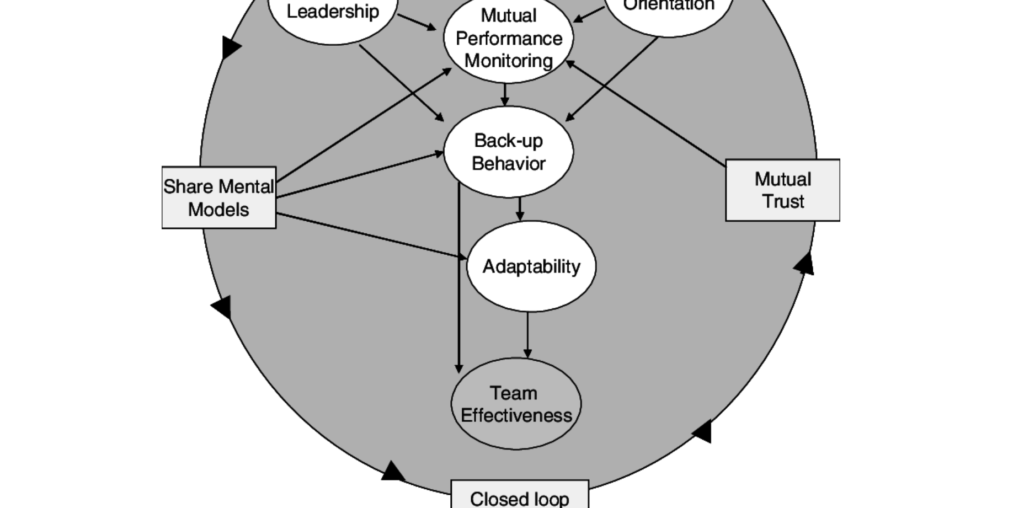
 Source: Salas et. al – Researchgate
The seminal paper by Eduardo Salas and colleagues introduced the Big Five Model of Teamwork (B5T) as an integrative framework for understanding the behavioural processes that underpin effective team performance in complex environments.
The authors reviewed a large body of teamwork literature and synthesised more than a hundred previously proposed teamwork frameworks into five core teamwork behaviours:
- team leadership
- mutual performance monitoring
- backup behaviour
- adaptability
- team orientation
These behaviours describe how team members coordinate actions, monitor each other’s work, support overloaded colleagues, adjust to changing conditions, and maintain commitment to collective goals. The model was developed specifically to explain how teams function effectively in high-risk and high-reliability contexts, such as aviation, the military, and emergency response.
The paper also proposes that these five behaviours are supported by three coordinating mechanisms:
- shared mental models
- mutual trust
- closed-loop communication
which enable teams to synchronise their actions and maintain a common understanding of tasks and roles. Salas and colleagues argue that these mechanisms allow the behavioural processes to function effectively, ultimately leading to improved team effectiveness and performance outcomes.
The model has since become one of the most influential frameworks in human factors, organisational psychology, and safety-critical industries, providing a theoretical foundation for practices such as Crew Resource Management (CRM), behavioural marker systems, and non-technical skills training used in aviation and other complex sociotechnical systems.
Reference:
Salas, E., Sims, D. E., & Burke, C. S. (2005). Is there a “Big Five” in teamwork? Small Group Research, 36(5), 555–599. https://doi.org/10.1177/1046496405277134